The Stoic Simple Blog

You Have a Beautiful Mind. Learn to Use It the Right Way With Stoicism.

“You are not your body or your hairstyle, but your capacity for choosing well. If your choices are beautiful, so too will you be.”

Epictetus


You have a beautiful mind.

I’m not talking about how intelligent or clever you are. I’m talking about a gift you were born with that’s worth more than all the money in the world.

It’s your ability to choose. To choose how you respond to challenges, to choose how you see the world, to choose what your attitude will be in any circumstances.

Your mind is the product of thousands of generations of people before you who adapted to tough situations, who stayed resilient in the face of challenges, who persisted in spite of pain and loss and struggles you can’t even imagine.

You were born with those same abilities. You were given every tool you need to fix the problems that life sends your way. Being resilient and facing challenges is what you were made to do.

Your mind controls your emotions . . . not the other way around. You are not defined by your body or your possessions or your circumstances. You’re defined by your judgments of those things, and how you choose to respond to them.

Your mind the only thing you truly own, the only thing you have total control over. Everything else can be taken away from you . . . but no one can ever take away your ability to choose how you respond.

Regardless of what challenges you’re facing, regardless of what mistakes you’ve made, regardless of what the world gives you . . .

You can choose to be unconquered.

You can choose to be happy.

Focus on the Rowing, Not on What Lies Beneath the Waves

“Questions beyond our knowledge we should ignore, since the human mind may be unable to grasp them. What would we gain from understanding every little thing, anyway?” — Epictetus

It’s good to be educated about the world around us and how it works. But happiness doesn’t come from constantly seeking out more useless data and info and news.

Pursuing knowledge is like navigating an ocean: we should learn how to traverse the water’s surface, but diving too deep beneath the waves will only bend us away from living.

You’ll never catalog every drop of water in the sea or wrest control from tempests, so don’t be distracted by the endless mysteries and terrors of the abyss. Instead, focus on the simple, vital task of rowing your boat.

Think about the beautiful relevance of what’s right in front of you: the small instead of the vast, the ordinary instead of the profound, the familiar instead of the exotic.

The most transformative discoveries are hiding in the mundane requirements of everyday life, not in endless information and facts and findings.

“Help and harm are only found within ourselves” — Epictetus | Quick Stoic Quotes

“Average people think that anything helpful or harmful comes from others. Extraordinary people know that help and harm are only found within ourselves.” — Epictetus

There’s nothing wrong with seeking help from others. But Epictetus reminds us that we’re already equipped with every tool we need to fix the challenges that life sends our way.

And his advice goes much deeper than that.

Remember: it’s not just help that can be found exclusively in ourselves, but also harm. Most “bad” situations are only harmful to us because we decide that they’re harmful.

Does that mean we can just choose to not feel pain from an injury or loss? Of course not. But we can choose to use those experiences to better ourselves and the world around us.

You really can decide that challenging experiences — no matter how unpleasant they are — aren’t allowed to harm you.

“Humans are here for the sake of each other” — Marcus Aurelius | Quick Stoic Quotes

“Humans are here for the sake of each other. So either teach them, or learn to bear them.” — Marcus Aurelius

We don’t like to admit it, but there’s a small part inside all of us that still feels like a child, confused by the world and unsure how to act. That part of us wants to do the right thing, but hasn’t yet learned what the right thing is.

Some of the people who you dislike probably act the way they do just to cope with hidden fears and insecurities, or because they don’t know how they should act.

When children make mistakes or imitate something they don’t know is wrong, should we yell at them? Or should we show patience and teach them how to do it correctly?

Next time you start getting frustrated with someone, pause and imagine how they were as a child, lost and seeking direction. Remind yourself that they might still feel that way, on the inside.

If showing them the right path feels beyond your reach, then at least try to be patient with them as they discover the answers on their own.

“Do you think this is why we were made strong?” — Seneca | Quick Stoic Quotes

“Do you think this is why we were made strong — just so we could have light burdens to bear?” — Seneca

As human beings, we have the unique ability to transform the toughest stuff the world can throw at us into opportunities.

Stop looking at challenges as something you have to face.

We don’t have to face challenges, we get to face them. We don’t have to go to work every day, we get to go to work every day. We don’t have to adapt to uncomfortable changes, we get to adapt to uncomfortable changes.

This is what human beings were made to do. We’ve earned our resilience and our strength over thousands of generations.

Birds weren’t given wings just to walk everywhere . . . and you weren’t born with resilience and a beautiful mind just to have an easy life.

Stop telling yourself that you have to do the tough things that life requires. You get to do them. It’s why you were given strength.

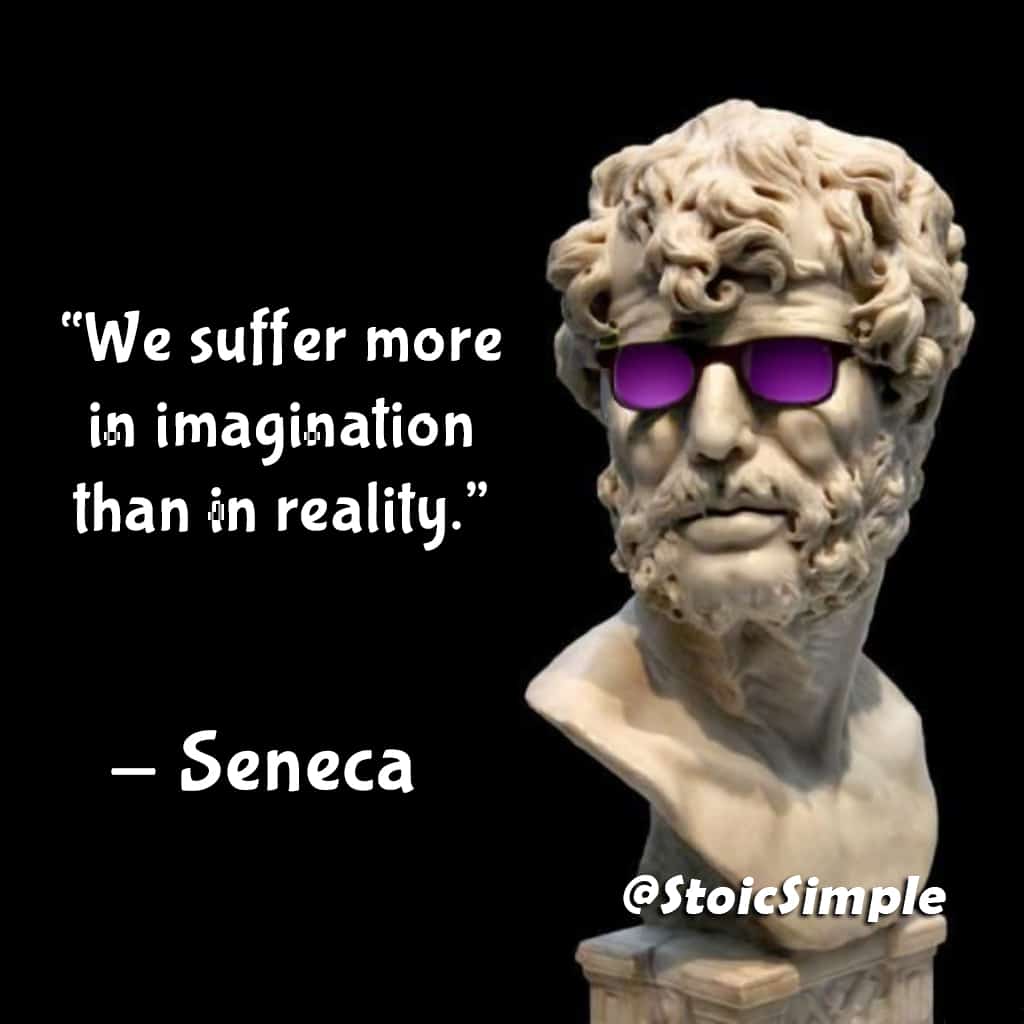
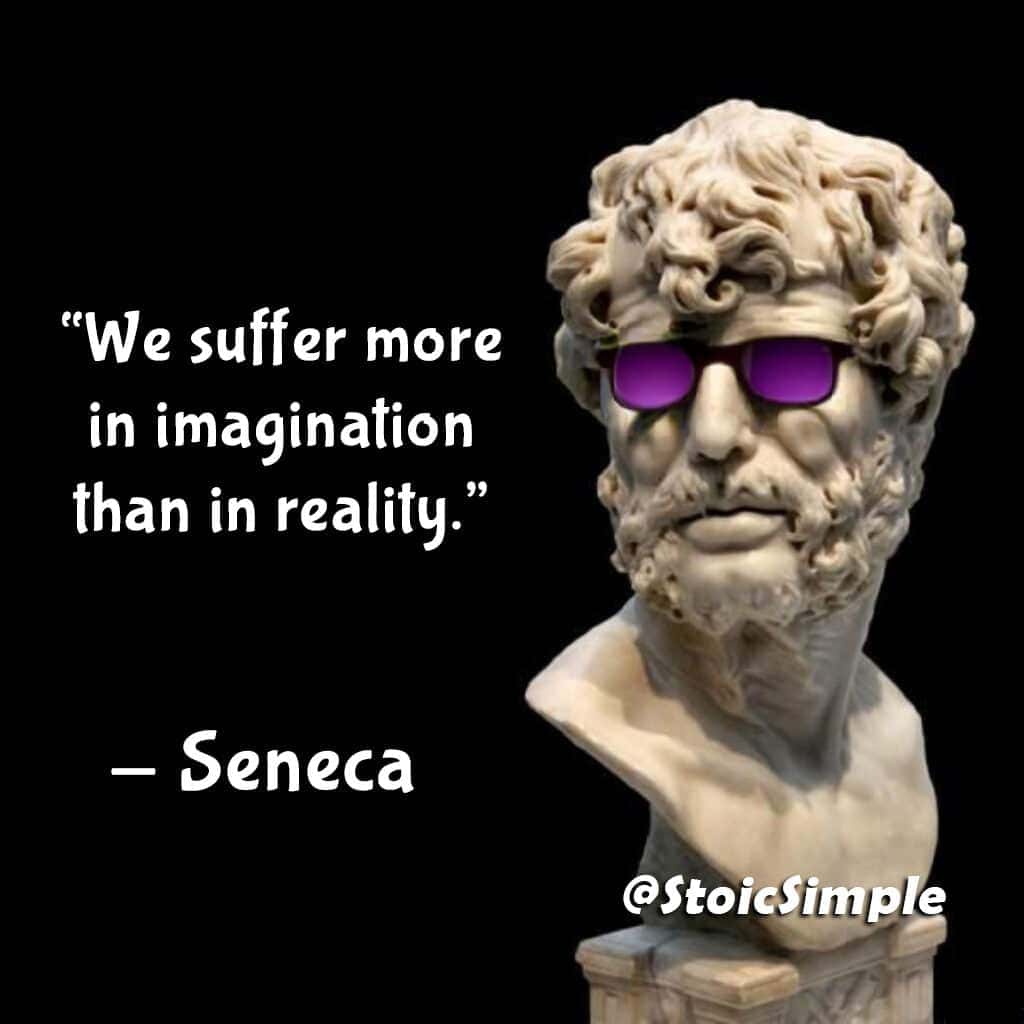
“We suffer more in imagination than in reality.” — Seneca | Quick Stoic Quotes

“We suffer more in imagination than in reality.” — Seneca

When your thoughts stray from the present, happiness often slips away. Dwelling on the past? It can lead to bitterness and regret. Fixating on the future? That’s a recipe for fear and anxiety.

Staying anchored in the present is the key to less suffering. What’s happening now, what’s directly in front of you – these should be the focus of your mind. It’s not always easy, but it’s worth it.

Training your mind to stay present is a journey, not an instant change. Each moment you bring your thoughts back to the now is a step towards a more peaceful life. 

Why is focusing on the present so powerful? It frees you from the chains of past mistakes and future worries. It allows you to live more fully, appreciating life as it unfolds.

Remember, training the mind is a practice. Just like learning a new skill, it takes time, patience, and consistent effort. But the payoff? A more serene, contented life.

So, next time you find your mind wandering into the realms of ‘what was’ or ‘what could be,’ gently guide it back. Back to the now, to the real, to the present moment. That’s where true peace lies.

Seneca’s words resonate through time because they hold a profound truth. Living in the present is a liberating path to a happier, more fulfilled life. Let’s embrace it, one mindful moment at a time.

Modern Stoic Quotes From Phil Van Treuren

Phil Van Treuren is the author of The Urban Enchiridion, A Dog Who Follows Gadly, The Little Book of Stoic Quotes and many more works on modern Stoicism.


“Human beings are the same joyful, resilient, imperfect people today that we were 100 years ago, 1,000 years ago, and 10,000 years ago. We have the same 𝘣𝘦𝘢𝘶𝘵𝘪𝘧𝘶𝘭 minds.” (Source)


“Whether they realized it or not, the actions of those who loved us in our youth are often more valuable than the written words of any ancient philosopher.” (Source)


“When driving by certain places that played a painful role in my past life, I used to get a feeling of dread and think to myself ‘thank God I’m not 𝘵𝘩𝘦𝘳𝘦 anymore.’ Now, I get a feeling of gratitude and think to myself ‘thank God I 𝘨𝘰𝘵 to be there, because it allowed me to be 𝘩𝘦𝘳𝘦 today.'” (Source)


“The good is in how you lift them.” (Source)


“If you’re indulging in nostalgia, be careful not to fall into the trap of thinking ‘today must be bad, because yesterday was better.'” (Source)


“When the only thing left to do is die, then die well.” (Source)


“You’ll never catalog every drop of water in the sea or wrest control from tempests, so don’t be distracted by the endless mysteries and terrors of the abyss. Instead, focus on the simple, vital task of rowing your boat.” (Source)


“Birds weren’t given wings just to walk everywhere . . . and you weren’t born with resilience and a beautiful mind just to have an easy life.” (Source)


“Those of us who are able to accept a quickly changing world and learn new ways of doing things are going to have a huge advantage as this century unfolds. We shouldn’t be afraid to embrace new technologies that make it easier to do the things we love and magnify our natural talents.” (Source)


“Stoic thought wasn’t created by philosophers, it was identified by them . . . Even if we lost every word that was ever written about Stoicism, the concepts would be re-discovered by human beings again and again.” (Source)


“Pursuing knowledge is like navigating an ocean: we should learn how to traverse the water’s surface, but diving too deep beneath the waves will only bend us away from living.” (Source)


“We’re rarely given the teachers we need when life’s inevitable hardships leave us crestfallen and confused. Fortunately, we have the ability to linger among humanity’s noblest minds and choose mentors for ourselves.” (Source)


“Your actions might be up to you, but the outcomes are not. So stop judging yourself on whether or not you hit your targets. Instead, focus on how well you prepared for it. Focus on the process, not the outcome.” (Source)


“‘What’s the meaning of life?’ There are few questions that are more human — and few that are more arrogant to ask. It’s a bit like going to a job interview and demanding to know what they can do for you, rather than showcasing why you’re perfect for the position.” (Source)


“We don’t like to admit it, but there’s a small part inside all of us that still feels like a child, confused by the world and unsure how to act. That part of us wants to do the right thing, but hasn’t yet learned what the right thing is.” (Source)


“Fury is the weak person’s idea of strength, and saber-rattling is the simpleton’s idea of strategy. Focused calmness wins battles.” (Source)


Famous Christian Stoics: Christianity and Stoicism

Stoicism, a school of Hellenistic philosophy founded in Athens by Zeno of Citium, has profoundly influenced various thinkers throughout history, including notable Christian figures. This philosophical system emphasizes virtues like wisdom and temperance, fostering resilience and inner peace. Its principles have seamlessly blended with Christian teachings, resulting in a unique amalgamation of thought and belief.

Among the earliest Christian Stoics, Justin Martyr stands out. Born in Samaria, he initially studied various philosophical systems before converting to Christianity. His writings often reflect Stoic ideals, particularly the emphasis on rational divine order and ethics. Martyr’s synthesis of Stoicism and Christianity helped shape early Christian apologetics, demonstrating a harmonious relationship between faith and reason.

Another key figure, Tertullian, a prolific early Christian author from Carthage, also exhibited Stoic influences in his works. While he later criticized certain aspects of pagan philosophy, his early writings reveal a deep appreciation for Stoic principles, particularly their ethical teachings. Tertullian’s integration of these ideas into his theological works illustrates the adaptability of Stoic philosophy to Christian thought.

Moving into the Renaissance, Desiderius Erasmus, a Dutch philosopher and theologian, displayed a Stoic-Christian synthesis in his approach to life and religion. His advocacy for education, moral self-discipline, and inner piety resonates with Stoic virtues. Erasmus’s emphasis on the importance of inner spiritual life over external rituals aligns closely with Stoic introspection and self-control.

In modern times, Dietrich Bonhoeffer, a German theologian and anti-Nazi dissident, echoed Stoic-Christian ideals. His emphasis on personal responsibility, ethical action, and facing adversity with courage and integrity draws parallels with Stoic thought. Bonhoeffer’s life and writings, particularly during his resistance against the Nazi regime, exemplify the Stoic virtues of courage and justice, seamlessly integrated into his Christian faith.

Stoicism’s impact extends to American historical figures as well. Consider Reverend Dr. Martin Luther King Jr., whose nonviolent resistance and emphasis on love and forgiveness reflect Stoic endurance and fortitude. His speeches and writings often echo the Stoic principle of universal brotherhood, harmonizing with Christian teachings of love and compassion.

The enduring legacy of Stoicism within Christian thought is undeniable. These historical figures, spanning from ancient times to the modern era, exemplify how Stoic philosophy can enrich Christian theology and practice. Their lives and teachings highlight the compatibility and mutual reinforcement of Stoic and Christian virtues.

Exploring the interplay between Stoicism and Christianity offers insightful perspectives on how ancient philosophy can complement and deepen religious faith. The lives of these individuals provide compelling examples of how Stoic virtues like resilience, temperance, and ethical living can harmonize with Christian values of love, forgiveness, and faith. This fusion of philosophical and religious principles continues to inspire and guide many in their spiritual and moral journeys.

What Are the Major Principles and Tenets of Stoicism?

Stoicism, a school of Hellenistic philosophy, has been influencing thinkers and leaders for centuries. Founded in Athens by Zeno of Citium in the early 3rd century BC, this philosophical doctrine emphasizes the development of self-control and fortitude as a means to overcome destructive emotions. Stoicism is not merely a set of abstract concepts; it’s a practical philosophy aimed at bettering one’s life and mental well-being.

At the heart of Stoicism lies the belief in living in harmony with nature and understanding the universe as a rational and orderly entity. Stoics argue that by recognizing the natural order of the world, one can attain true contentment. They advocate for a life led according to reason and virtue, viewing these as the fundamental components of human happiness.

Another key principle in Stoicism is the concept of ‘apatheia’ or freedom from emotional turmoil. Stoics strive to maintain a state of tranquility by managing their reactions to external events. They teach that while we cannot always control what happens to us, we can control how we respond. This focus on internal control is central to Stoic philosophy, emphasizing the importance of personal responsibility in the pursuit of a fulfilling life.

Stoics also discuss the concept of ‘eudaimonia’, often translated as happiness or flourishing. For them, eudaimonia is achieved through the exercise of virtue and is the ultimate goal of human existence. Unlike fleeting pleasures, eudaimonic happiness is a stable and lasting state that results from living a life of moral and intellectual excellence.

Stoicism also teaches the importance of understanding the difference between what is within our control and what is not. This distinction is crucial for maintaining mental peace and effective decision-making. Stoics believe that worrying about things outside our control is futile and leads to unnecessary suffering.

Another significant aspect of Stoicism is its emphasis on community and universal brotherhood. Stoics hold that all humans are manifestations of the same universal reason. Consequently, they advocate for justice, fairness, and kindness towards others. This sense of connectedness with the broader human community is a key element of Stoic ethics.

Additionally, Stoicism addresses the transient nature of life and material possessions. Stoics remind us that life is short and unpredictable, urging us to focus on what truly matters. They encourage an attitude of detachment towards external possessions and social status, teaching that true value lies in one’s character and actions.

In examining these principles and tenets, it becomes evident that Stoicism offers more than philosophical teachings; it provides a way of life. Embracing Stoicism can lead to significant improvements in personal resilience, emotional stability, and overall life satisfaction. This ancient philosophy, with its timeless wisdom, continues to be relevant in the modern world, offering guidance and insights for dealing with life’s challenges.

As we reflect on the teachings of Stoicism, we realize its profound impact on how we perceive and interact with the world around us. Embodying Stoic principles means cultivating a strong moral character, practicing self-discipline, and fostering a sense of global kinship. It’s about recognizing the power of our own responses and choosing a path of virtue and reason. In embracing these ideas, we find a robust framework for living a balanced and meaningful life.

What is a Stoic Person Like, How Do They Act & Behave?

Stoicism, an ancient philosophy, teaches resilience and emotional control. Its practitioners, known as stoics, exhibit unique characteristics in both thought and behavior. Stoic individuals often display a calm demeanor, especially in challenging situations. They believe in maintaining a level head, irrespective of the external environment.

For stoics, emotional regulation is crucial. They strive to understand their feelings, aiming not to suppress but to control them. This approach helps stoics remain balanced in the face of life’s ups and downs. Their emotional intelligence is frequently high, enabling them to navigate interpersonal relationships with empathy and understanding.

When it comes to decision-making, stoics are known for their practicality. They focus on what is within their control, letting go of worries about things they cannot change. This mindset fosters a sense of empowerment and reduces unnecessary stress. Stoics make decisions based on reason rather than impulse, often leading to more thoughtful and effective outcomes.

In their daily lives, stoics practice gratitude and contentment. They appreciate what they have and do not constantly seek more. This attitude leads to a life marked by simplicity and fulfillment. Stoics find joy in the ordinary, valuing experiences over material possessions.

Stoics are also known for their resilience. They view challenges as opportunities for growth, not as obstacles. This perspective allows them to face adversity with courage and determination. Stoics do not shy away from difficulties but embrace them, knowing each challenge helps them grow stronger.

In social situations, stoics are often seen as reliable and stable. They tend to be good listeners, offering balanced and thoughtful advice. Their approach to life attracts others seeking wisdom and stability. However, stoics are selective in their social interactions, preferring meaningful connections over superficial relationships.

Regarding personal development, stoics are committed to continuous growth. They regularly engage in self-reflection, seeking to understand themselves better and improve. Stoics value learning and growth, both intellectually and emotionally. They understand that personal development is a lifelong journey, not a destination.

Stoics also exhibit a strong sense of duty and responsibility. They believe in doing what is right, often prioritizing the greater good over personal gain. This ethical approach to life earns them respect and admiration from others. Stoics are seen as trustworthy and honorable, qualities that greatly influence their personal and professional relationships.

Stoicism is more than just a philosophical concept; it is a way of life. Stoic individuals navigate the world with calmness, practicality, and resilience. They are emotionally intelligent, pragmatic in decision-making, and lead lives marked by simplicity and contentment. Stoics embrace challenges, value personal growth, and exhibit strong ethical principles. Their unique approach to life offers valuable lessons for anyone seeking emotional balance and fulfillment.

Exit mobile version