

The Stoic Simple Blog

Stoic Parenting: What are strategies to teach my child to value community and relationships?


From The Stoic Parenting Guide: How Stoicism Teaches Us to Raise Resilient Children


Raising a child in today’s fast-paced world can often feel like a daunting challenge. While the stakes seem high, Stoic philosophy offers timeless insights on instilling the values of community and relationships in your child’s life. Teaching your child these Stoic principles will not only enrich their own life but also contribute to the well-being of those around them.

Start by introducing the idea that every individual is part of a larger social fabric. Just as the hand is useless without the arm, so too is the person without the community. Teach your child the value of their actions and words by emphasizing how they affect the larger whole. For example, when they share their toys or offer help to a friend in need, point out how their actions have created a ripple effect of positivity. This reinforces the Stoic teaching that each of us plays a role in shaping the social ecosystem.

Encourage them to practice empathy and to view the world through the eyes of others. When they can put themselves in someone else’s shoes, they’re more likely to treat them with kindness and respect. When conflicts arise, ask your child to think about how the other person might be feeling, and what might be driving their behavior. Teaching your child to give others the benefit of the doubt and to forgive helps in creating a harmonious community.

Cultivating relationships is akin to tending a garden; it requires consistent effort and care. Encourage your child to nurture their friendships by being present, listening, and showing appreciation. Remind them that friendships are two-way streets and that they should also be there for their friends when they’re in need. Help them understand that while they can’t control what others do, they can control their reactions. The quality of their friendships, to a large extent, depends on the quality of their own actions and attitudes.

Importantly, encourage your child to understand that community involvement is an essential component of a fulfilling life. You can illustrate this through family activities that involve giving back to the community, such as volunteering at a local shelter or participating in a neighborhood clean-up. These activities are opportunities to impart the Stoic idea that our well-being is intrinsically linked to the well-being of the community we live in.

Through your example, show your child how to face challenges within relationships and community settings with resilience and a calm mind. Teach them to interpret challenges as opportunities to learn and grow, rather than as setbacks. When they realize that adversity is an integral part of life, they’re more likely to engage with their community and relationships in a constructive way.

Ultimately, a strong sense of community and robust relationships don’t just happen; they are built on a foundation of shared values and mutual respect. By embracing the Stoic principles of interconnectedness, empathy, and the cultivation of character, you’ll arm your child with the tools they need to create a life rich in community and meaningful relationships.



Enjoying these stories? Get your own copy of one of our beautifully illustrated Stoic fables!


Stoic Parenting: How can I help my child recognize and control impulsive behavior?


From The Stoic Parenting Guide: How Stoicism Teaches Us to Raise Resilient Children


Raising a child to become a well-adjusted adult is no small feat, and impulsive behavior can be a particular challenge to handle. You’ve probably already noticed that elementary school-age children are prone to emotional outbursts, hasty decisions, and actions without thinking. If you’re a parent who appreciates the wisdom of Stoic philosophy, then you’ve got a valuable toolkit at your disposal. Stoicism can offer your child concrete ways to recognize and control impulsivity.

To begin with, teach your child the Stoic practice of understanding what is within their control and what is not. In moments of impulsivity, children often react to external circumstances without considering their actions. When your child is upset or excited and on the verge of an impulsive act, remind them to pause and think about what aspects of the situation they can control. You could say something like, “Remember, you can’t control what happened, but you can control how you react to it.” This helps lay the foundation for self-regulation, making it easier for your child to stop and think before acting.

Another important Stoic principle that can help is the idea of “premeditatio malorum,” or premeditating on potential negatives. When children act on impulse, they usually don’t think about the potential consequences. The idea isn’t to make your child anxious about all the things that could go wrong but to help them visualize potential outcomes. For example, before going on a playdate where they’ve had issues sharing toys in the past, you might say, “Let’s think about how you want this playdate to go. What could happen if you don’t share?” This practice can become a habit, making your child more mindful of their actions over time.

Reflection and self-examination are also central tenets in Stoicism that can be of great help. After an episode of impulsive behavior, guide your child through a reflective process. Ask open-ended questions like, “Why do you think you acted that way?” or “How did your action affect others?” Avoid judging their responses; the goal is to encourage self-awareness. This practice can go a long way in helping your child recognize triggers and patterns in their behavior.

Moreover, the Stoic idea of detachment can be useful in dealing with impulsivity. Help your child understand that they don’t have to be enslaved by their immediate desires or feelings. For instance, if they are feeling overly excited and are about to grab a toy from another child, help them practice detachment by stepping back emotionally for a moment. You could say, “I know you really want that toy, but let’s take a deep breath first.” This momentary step back allows them to assess the situation and make a more rational decision.

Stoicism provides an excellent framework to address the issue of impulsive behavior in children. By applying its principles, you can guide your child towards greater self-control, awareness, and ultimately, wisdom. So the next time your child faces a situation that triggers impulsive behavior, remember these Stoic principles. You’ll be amazed at how well they work, not just for your child, but for you as well.


Enjoying these stories? Get your own copy of one of our beautifully illustrated Stoic fables!


Stoic Parenting: How can I model the importance of inner strength for my child?


From The Stoic Parenting Guide: How Stoicism Teaches Us to Raise Resilient Children


As a parent, you’re not just raising a child; you’re nurturing the development of a future adult. Naturally, you want to equip your child with all the tools they’ll need to navigate the ups and downs of life. While teaching them to read, write, and solve math problems is essential, what about building their inner strength? That’s where the principles of Stoic philosophy can be a godsend.

Imagine a typical morning in a household with kids. Breakfast needs to be made, teeth need to be brushed, and the clock is ticking. Your child can’t find their favorite shirt and starts to throw a fit. Now, Stoicism teaches us that we can’t control the external world, but we can control how we react to it. In this situation, losing your temper won’t find the shirt or make the morning go more smoothly. By keeping your composure, you’re demonstrating the importance of inner strength to your child. You’re showing them that life will throw curveballs, but we can choose not to be overwhelmed by them.

Children look up to their parents and often mimic their behavior. If they see you dealing with stress, annoyance, or even hardship with a calm demeanor, they’ll naturally absorb this as the standard way to handle life’s challenges. This doesn’t mean you should be a stoic robot without any emotions. It’s entirely appropriate to express feelings, but the key lies in how you manage those feelings and the situations that trigger them.

Let’s consider another scenario where your child faces difficulty at school—maybe they’ve gotten a bad grade or had a disagreement with a friend. The Stoic way would involve discussing what parts of the situation are within their control and what parts aren’t. Maybe they can’t change how the teacher grades or how their friend behaves, but they can invest time in studying or choose how to communicate with their friend. The goal is to encourage your child to focus their energy on what they can control, empowering them to recognize their inner strength and develop resilience.

While it might be tempting to solve all your child’s problems for them, this doesn’t give them the opportunity to build inner strength. It’s like giving them a fish instead of teaching them how to fish. Your job is to guide and support them in solving their own problems. You provide the safety net, but you allow them the freedom to make choices, face natural consequences, and learn from their experiences. This shows trust in their abilities, which in turn builds their self-confidence and inner strength.

By embodying the virtues of Stoicism in your everyday interactions, you’re doing more than modeling behavior. You’re setting your child up to face the world as an empowered individual, grounded in the understanding that while they can’t control everything that happens to them, they can always control how they respond. And that’s a life lesson worth teaching.


Enjoying these stories? Get your own copy of one of our beautifully illustrated Stoic fables!


Stoic Parenting: What are ways to teach my child about perseverance?


From The Stoic Parenting Guide: How Stoicism Teaches Us to Raise Resilient Children


Teaching your child about perseverance is one of the most valuable life skills you can impart, and what better framework to use than the enduring wisdom of Stoic philosophy? While Stoicism offers many principles, let’s delve into specific practices that can foster a strong sense of perseverance in your young one.

Firstly, focus on what’s within your control. Imagine your child has a difficult math problem to solve, and they’re frustrated. A Stoic approach would be to help them separate the elements they can control—like the time they spend practicing—from those they can’t control, such as the intrinsic difficulty of the problem. This enables your child to divert energy towards actions that yield results. You can say something like, “You can’t change how hard the problem is, but you can change how you approach it.”

Another effective way to teach perseverance is through the principle of amor fati, or “love of fate.” The idea is to teach your child to embrace challenges, even relish them, as opportunities for growth. If they get knocked down in a soccer game or get a lower grade than they hoped for, help them reframe these events as experiences that can help them improve. Instead of shielding them from setbacks, encourage them to welcome these obstacles as teachers.

A third Stoic practice to embed in your parenting is the concept of negative visualization. This is the act of mentally preparing for the worst-case scenario, but not in a pessimistic way. For example, before a school performance or a big test, you can talk with your child about what the worst outcome could be. This enables your child to recognize that even the worst situation often isn’t catastrophic, thereby reducing anxiety and empowering them to try their best without the debilitating weight of “what if.”

Lastly, let’s consider the Stoic journaling practice, which even a young child can participate in with your help. Make it a bedtime ritual to discuss the challenges they faced that day, how they responded, and how they can improve tomorrow. This reflective practice can help your child develop a keen sense of self-awareness and serves as a roadmap for perseverance. They begin to learn the cycle of assessing a situation, acting, and then reassessing based on the outcome.

In teaching these Stoic principles, remember that consistency is key. It’s not about a one-off lecture but a sustained ethos that you integrate into everyday life. Furthermore, you serve as the most potent role model for your child. So, it’s not just about telling them how to be Stoic; it’s about showing them through your actions. If you exhibit perseverance through life’s challenges, it’s far more likely that your child will pick up on these invaluable traits.

So, when the going gets tough, which it inevitably will, both you and your child can rely on these Stoic tools for living a life of perseverance. They’re timeless strategies, not just for surviving, but truly thriving, no matter what life throws your way.


Enjoying these stories? Get your own copy of one of our beautifully illustrated Stoic fables!


Stoic Parenting: How can I help my child learn to prioritize their needs?


From The Stoic Parenting Guide: How Stoicism Teaches Us to Raise Resilient Children


Raising a child in today’s fast-paced, emotionally charged world can be overwhelming. You may find yourself wondering how to equip your child with the tools to make wise decisions and prioritize their needs effectively. Stoicism, an ancient philosophy practiced by some of history’s greatest minds, offers valuable insights for this parenting challenge.

The core tenet of Stoicism is that we can’t control external events, only our reactions to them. Your child will face a myriad of choices and challenges—some trivial, like choosing between two toys, and some significant, like dealing with conflict at school. The Stoic approach emphasizes understanding the difference between external influences and internal judgments.

A helpful concept here is the Stoic idea of “preferred indifferents.” Stoicism teaches us that some things are neither inherently good nor bad, but they can be “preferred” if they align with virtuous living. For instance, health, education, and friendships are not necessarily good in themselves, but they can be good when they promote a virtuous life. Instilling this idea in your child helps them to prioritize needs over wants.

Let’s consider schoolwork. Your child might not enjoy doing homework and would rather play video games. Both activities are indifferent in Stoic terms, but one aligns more closely with the virtues of discipline and wisdom. Teaching your child to see the deeper value in completing their homework can help them naturally prioritize it over short-term pleasure. You’re not just imposing a rule, but helping them internalize a way to make beneficial choices.

The Stoic principle of “Eudaimonia,” or flourishing, provides another guiding light. A flourishing life is one lived in accordance with reason and virtue. You can pose questions that lead your child to think critically about what really matters for their well-being. Instead of asking, “What do you want to do?”, you might ask, “What’s the best thing for you to do right now?” This subtly shifts their thinking from immediate desires to long-term needs and aspirations.

Another Stoic tool for decision-making is the “View from Above.” It’s a mental exercise that involves imagining looking down at one’s life from a high vantage point, thus gaining a broader perspective. Teach your child to use this tool when they’re torn between options. A broadened viewpoint can help them identify what’s genuinely important and what’s not. For example, skipping a difficult task may bring immediate relief but completing it would offer long-lasting benefits.

Stoicism also encourages us to focus on our “Circle of Control,” which is particularly relevant in the realm of emotional well-being. Children often feel upset when they can’t control external situations. Explain that while they can’t control how others behave or what happens at school, they can control their reactions. This empowers them to focus on meeting their emotional needs, such as finding calm through deep breaths or asking for help when overwhelmed.

Applying Stoic principles in these ways offers your child a sturdy framework for prioritizing their needs over wants, and immediate comforts over long-term benefits. The virtue-centered Stoic approach equips them to navigate life’s complexities with resilience and wisdom, shaping not only their decisions but also their character.


Enjoying these stories? Get your own copy of one of our beautifully illustrated Stoic fables!


Stoic Parenting: How can I guide my child in learning forgiveness?


From The Stoic Parenting Guide: How Stoicism Teaches Us to Raise Resilient Children


As a parent, teaching your child the art of forgiveness can sometimes feel like a daunting task. You want them to grow up with the emotional resilience to overcome life’s challenges. Fortunately, Stoic philosophy offers profound wisdom on this topic, wisdom that you can pass on to your child for a healthier emotional life.

In Stoicism, the practice of forgiveness starts with the fundamental idea that you can only control your own thoughts and actions, not those of others. Teach your child that they can choose their reactions, regardless of someone else’s behavior. If a friend takes away their toy or a sibling says something hurtful, it’s a perfect opportunity to explain that while they can’t control what others do, they can control how they respond. By forgiving, they regain control over their own emotional state.

Marcus Aurelius once said, “The best revenge is to be unlike him who performed the injustice.” Talk to your child about how holding onto anger only damages their own well-being. When we refuse to forgive, we chain ourselves to the event that angered us, replaying it in our minds and allowing it to steal our tranquility. Forgiveness, in this sense, is not a favor we do for others but an act of self-preservation. You can explain this to your child by saying that when they forgive, they are choosing to let go of something heavy so they can be free to enjoy the present moment.

The Stoic principle of empathy also plays a significant role in the process of forgiveness. Teach your child to consider why someone may have behaved a certain way. Maybe the friend who took the toy was feeling left out, or the sibling who spoke harshly had a difficult day. While this doesn’t excuse the behavior, understanding it provides an alternative to anger. In talking through the perspective of others, you’re not only teaching your child to forgive but also to be empathetic and understanding, valuable life skills.

Another important facet is the concept of impermanence. In the grand scope of life, many things that seem significant now will be trivial later. Help your child put the situation in perspective. Today’s enemy could be tomorrow’s best friend, and the hurtful words that seem so important now will likely be forgotten in time. By appreciating the transient nature of life’s events, forgiveness becomes easier.

Lastly, Stoicism reminds us that the pursuit of virtue is the ultimate goal in life. Holding onto grudges or seeking revenge diverts us from this objective. Instead, show your child that by forgiving others, they’re practicing the virtues of wisdom, courage, justice, and self-control. When they understand that forgiveness is an act aligned with their highest ideals, it becomes a more accessible choice.

Teaching your child the Stoic principles behind forgiveness not only offers them immediate emotional relief but also equips them with a toolkit they can use throughout life. By emphasizing control over reactions, the importance of empathy, the transient nature of events, and the ultimate goal of virtue, you’re setting your child on a path toward emotional resilience and well-being.


Enjoying these stories? Get your own copy of one of our beautifully illustrated Stoic fables!


Stoic Parenting: How can I teach my child to appreciate simplicity?


From The Stoic Parenting Guide: How Stoicism Teaches Us to Raise Resilient Children


Teaching a child to appreciate simplicity may seem like a tall order in a world teeming with distractions and material desires. Yet, if you turn to the teachings of Stoic philosophy, you’ll find an invaluable guide for nurturing this invaluable trait. So, how can you impart the wisdom of Stoicism to help your child find joy in the simple things?

First off, be a role model. Actions often speak louder than words. Live a life that reflects the Stoic ideals of self-control, contentment, and appreciation for what you have. The more your child sees you valuing simplicity, the more likely they are to mirror that perspective. Whether it’s resisting the urge to buy the latest gadget or finding contentment in a peaceful walk, embodying these principles allows your child to observe simplicity in action.

Communication is another crucial element. Take time to discuss the beauty and importance of simple pleasures. You can point out moments that exemplify the virtue of simplicity—maybe it’s the tranquility experienced during a family meal, the happiness in reading a book together, or the joy of a nature hike. Use these opportunities to have candid conversations with your child, helping them recognize how these simple events contribute to a fulfilling life.

Stoic philosophy teaches us to focus on what we can control, and that includes our attitudes and reactions. Teach your child to manage their expectations and desires. Explain that wanting more and more rarely leads to long-lasting happiness, but appreciating what you already have does. Help them understand that their emotions and attitudes are within their own control, no matter the external circumstances.

Sometimes you’ll need to address societal pressures that glorify complexity and excess. Your child will inevitably be exposed to these messages, whether it’s through advertising or peer influence. While you can’t shield them from all external influences, you can teach them to question the messages they receive. Ask them how these messages make them feel and what they think they need for a good life. Help them see the difference between what society claims they should want and what genuinely contributes to their well-being.

Building resilience is another cornerstone of Stoicism that pairs well with appreciating simplicity. Teach your child that setbacks and hardships are part of life, but these obstacles offer lessons and opportunities for growth. When they understand this, the allure of materialism weakens, and the simple things gain prominence as sources of genuine happiness. Life’s adversities become easier to handle when your child learns to value the internal over the external.

Remember, instilling these Stoic principles is not a one-off lesson but a continual process of reinforcement. It may take time and patience, but the reward is a child who finds joy in the simple things, is resilient in the face of life’s challenges, and appreciates the richness of their internal world.

So, let the teachings of Stoic philosophy guide you as you walk this journey with your child, helping them develop a lifelong appreciation for the simple yet profoundly enriching aspects of existence.


Enjoying these stories? Get your own copy of one of our beautifully illustrated Stoic fables!


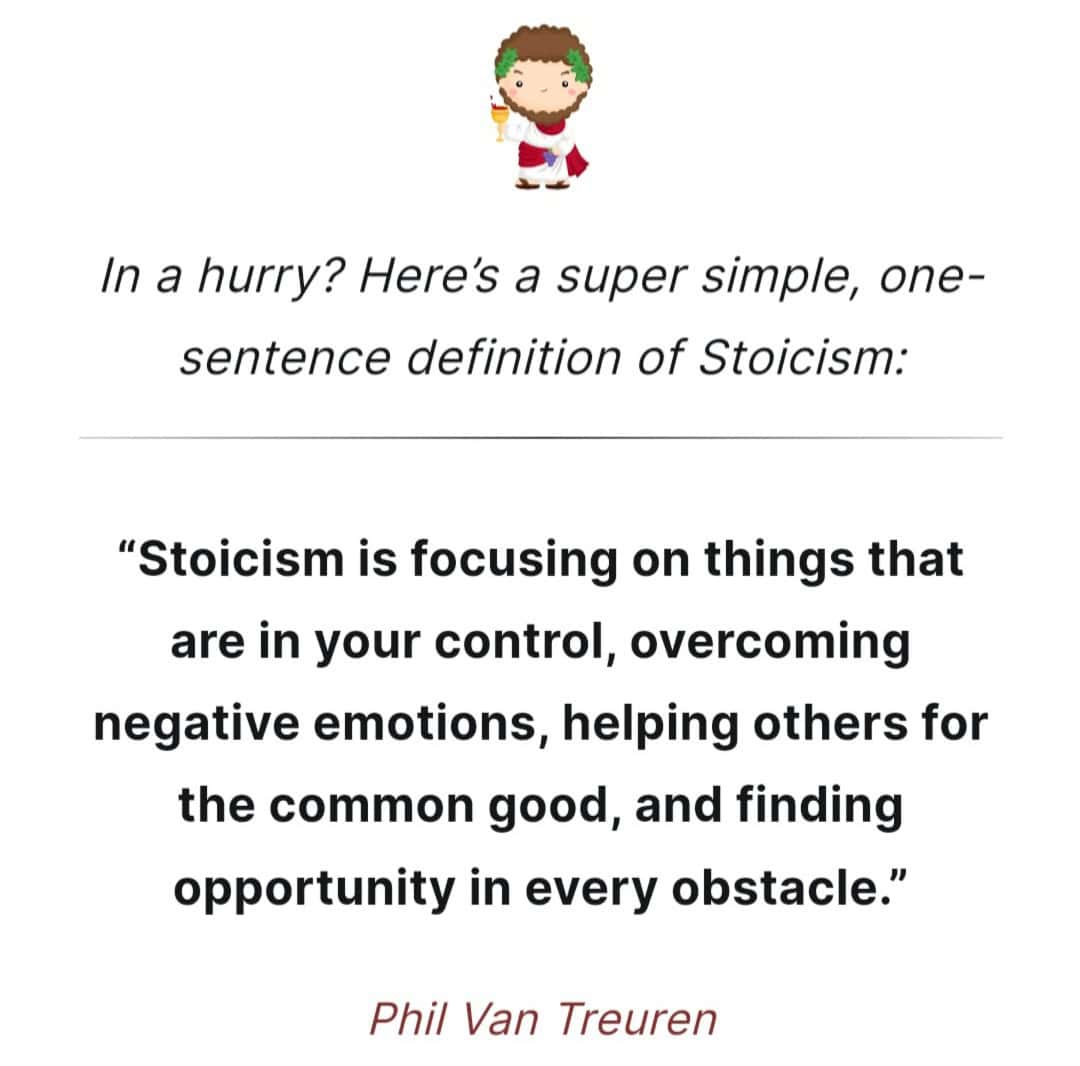
The Meaning of Stoicism in One Sentence


by Phil Van Treuren

What’s the simplest definition of Stoicism? Over the past year, I’ve been fine-tuning a simple, one-sentence description of Stoicism . . . and today it 𝘧𝘪𝘯𝘢𝘭𝘭𝘺 feels like it’s finished. There’s much more to the philosophy, of course, but I think this definition is equally concise, accurate and elegant.

I started the project by reaching out to two dozen modern Stoic writers & philosophers for feedback last year, and they were very receptive and helpful. I compiled all of their ideas on “the simplest one-sentence definition of Stoicism,” then started working on my own.

It was a great way to teach myself more about a topic that I love . . . and I published all of the responses I got from Stoic thinkers right here on Stoic Simple.

I hope you enjoy reading their answers as much as I enjoyed compiling them!

Stoic Parenting: What are ways to help my child cope with losing or failing?


From The Stoic Parenting Guide: How Stoicism Teaches Us to Raise Resilient Children


Losing and failing are part and parcel of life, and it’s inevitable that your child will experience these setbacks at some point. As someone familiar with Stoic philosophy, you know that how we react to circumstances is the only thing we truly control. With that in mind, you’re in a unique position to help your child not just cope, but thrive, in the face of adversity.

Firstly, focus on your child’s perspective. They may view a loss or failure as a devastating event, something that clouds their sense of worth or ability. Here’s where the Stoic practice of “reframing” comes in handy. Help them see the event not as a final judgment on their capabilities, but as a learning experience. Ask questions that lead to self-reflection: “What can we learn from this?” or “How can this make you stronger?” You’re not belittling their feelings; you’re guiding them to a different viewpoint where they can find constructive lessons.

Equally important is teaching your child the concept of the “dichotomy of control,” distinguishing between what’s within their control and what isn’t. For example, they may not be able to control the actions of their teammates in a soccer game or the questions on a surprise quiz, but they can control their own preparation, effort, and attitude. By focusing on these elements, they can still find a measure of success even in a situation that most people would label as failure. When children realize that they have control over their own actions and responses, it can be incredibly liberating.

Your child might still feel disappointment, and that’s perfectly okay. Stoicism doesn’t advise suppressing emotions, but rather understanding and navigating them. When your child comes to you with their feelings, don’t sweep them under the rug. Acknowledge them, and then guide your child toward understanding how those emotions fit into the larger picture. By doing this, you’re providing them with emotional intelligence skills that will last a lifetime.

Another key Stoic concept is that of impermanence. Remind your child that this moment of failure is but a fleeting experience in the grand scheme of things. A bad grade won’t define their academic career, nor will a missed goal cost them a lifetime of happiness. Life is ever-changing, filled with both wins and losses, and both are essential for growth. This thought can provide immediate comfort and a longer-term perspective that softens the blow of their current situation.

Lastly, embody the Stoic principles in your own life. Children are keen observers, and they’ll pick up on how you handle your own challenges. If you’re calm, rational, and optimistic even when facing difficulties, your child will naturally begin to adopt a similar approach. After all, the most effective teaching is by example.

Teaching your child to handle loss and failure through the lens of Stoic philosophy equips them with a resilience and self-awareness that can serve them well throughout their lives. It’s not just about making them feel better in the moment; it’s about setting them on a path where they can turn any situation, no matter how grim, into an opportunity for growth and learning.


Enjoying these stories? Get your own copy of one of our beautifully illustrated Stoic fables!


Stoic Parenting: How can I help my child to build healthy friendships?


From The Stoic Parenting Guide: How Stoicism Teaches Us to Raise Resilient Children


Building healthy friendships is an essential part of your child’s development, and Stoic philosophy can offer a rich toolkit for navigating these important relationships. Stoicism places a strong emphasis on self-control, rational thinking, and emotional resilience, all of which can help your child in their quest to build and maintain meaningful friendships.

Firstly, let’s talk about self-awareness and control over reactions. The Stoics firmly believed that while we can’t control external events, we can control how we respond to them. Teaching your child this fundamental concept can be incredibly empowering. For instance, if a friend is mean to them, help your child understand that their emotional reaction is their own responsibility. They can choose to be upset, or they can decide to approach the situation rationally, considering why the friend acted that way and whether the friendship is worth nurturing.

Control over emotions also extends to dealing with conflicts. Kids are still learning to manage their emotions, and petty arguments can often blow up into big issues. Stoicism teaches the importance of pausing and reflecting before reacting. Encourage your child to take a step back when faced with conflict, allowing them to respond in a more thoughtful and rational manner. This pause and reflection technique not only diffuses tension but also sets a strong foundation for resolving disputes amicably.

Stoicism also emphasizes the importance of virtues like honesty, courage, and wisdom. Encourage your child to be honest in their friendships, whether it’s sharing how they feel or admitting to a mistake. Honesty is the backbone of any strong relationship. Wisdom comes from knowing when to speak up and when to listen, when to stand your ground and when to be flexible. Help your child develop these virtues through consistent communication and reflection.

Community involvement is another Stoic principle that aligns well with friendship building. While Stoicism often focuses on individual virtues and personal growth, it also underscores the importance of being a good member of the community. Teach your child that friendships are a two-way street. This means not only should they find friends who treat them well, but they should also be that good friend to others. Encourage actions like sharing, showing empathy, and being kind. Let your child know that being a good friend will enrich their own life and contribute to the betterment of their community.

Lastly, it’s vital to teach your child the Stoic idea of understanding what is within their control. They can be the best friend possible, but they can’t control someone else’s actions. If a friendship isn’t reciprocated or if they face rejection, remind them it’s not a reflection of their worth but rather an external circumstance beyond their control.

By incorporating these Stoic principles, your child can build friendships that are not just numerous but also meaningful and enriching. These lessons will serve them well in their journey through life, creating not only stronger friendships but also a more harmonious inner world.


Enjoying these stories? Get your own copy of one of our beautifully illustrated Stoic fables!


Exit mobile version