The Stoic Simple Blog

Stoic Quotes on Love & Relationships: The Best Stoicism Sayings & Phrases

“Whether they realized it or not, the actions of those who loved us in our youth are often more valuable than the written words of any ancient philosopher.” — Phil Van Treuren


When it comes to relationships, Stoicism teaches that the best way to show appreciation to important people in your life (whether spouses, friends or family members) is to provide them with respect, support, kindness and honesty.

It’s a common misconception that being Stoic means that you shouldn’t show emotion in relationships, but that’s not the case at all. Stoicism teaches that we should rid ourselves only of negative emotions that have a bad effect on relationships, like jealousy, anger and suspicion.

The best Stoic quotes on relationships teach us to see our loved ones as they really are, not how we wish they would be. And to appreciate the unique aspects of their own character and experiences that we can learn from and utilize to make our own lives better, as well. True Stoics look at relationships between people as one of the most important interactions that can be found in nature.

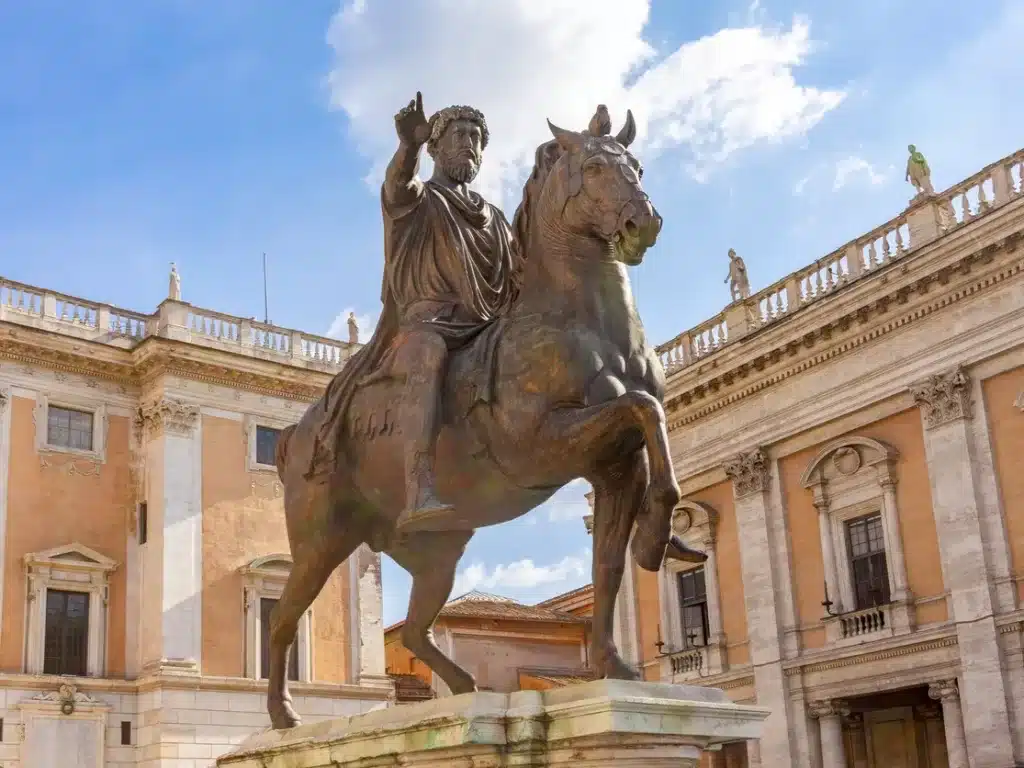
Stoic Quotes on Love & Relationships from Marcus Aurelius

“Accept the things to which fate binds you, and love the people with whom fate brings you together, but do so with all your heart.”

“Not to display anger or other emotions. To be free of passion and yet full of love.”

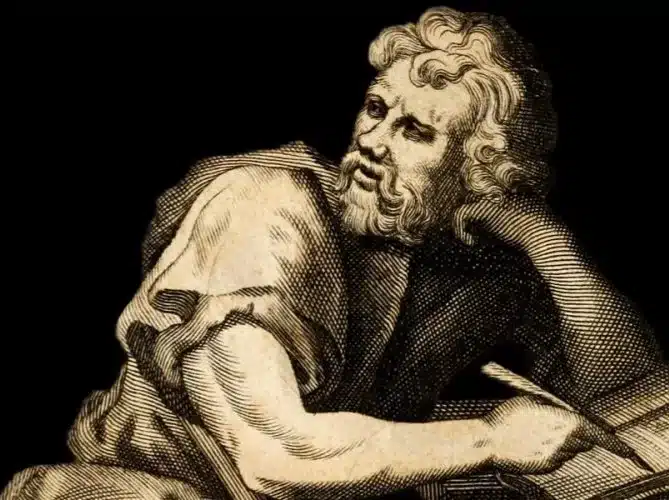
Stoic Quotes on Love & Relationships from Epictetus

(Your love) has been given to you for the present, not that it should not be taken from you, nor has it been given to you for all time, but as a fig is given to you or a bunch of grapes at the appointed season of the year. But if you wish for these things in winter, you are a fool.

With regard to whatever objects give you delight, are useful, or are deeply loved, remember to tell yourself of what general nature they are, beginning from the most insignificant things. If, for example, you are fond of a specific ceramic cup, remind yourself that it is only ceramic cups in general of which you are fond. Then, if it breaks, you will not be disturbed. If you kiss your child, or your wife, say that you only kiss things which are human, and thus you will not be disturbed if either of them dies.

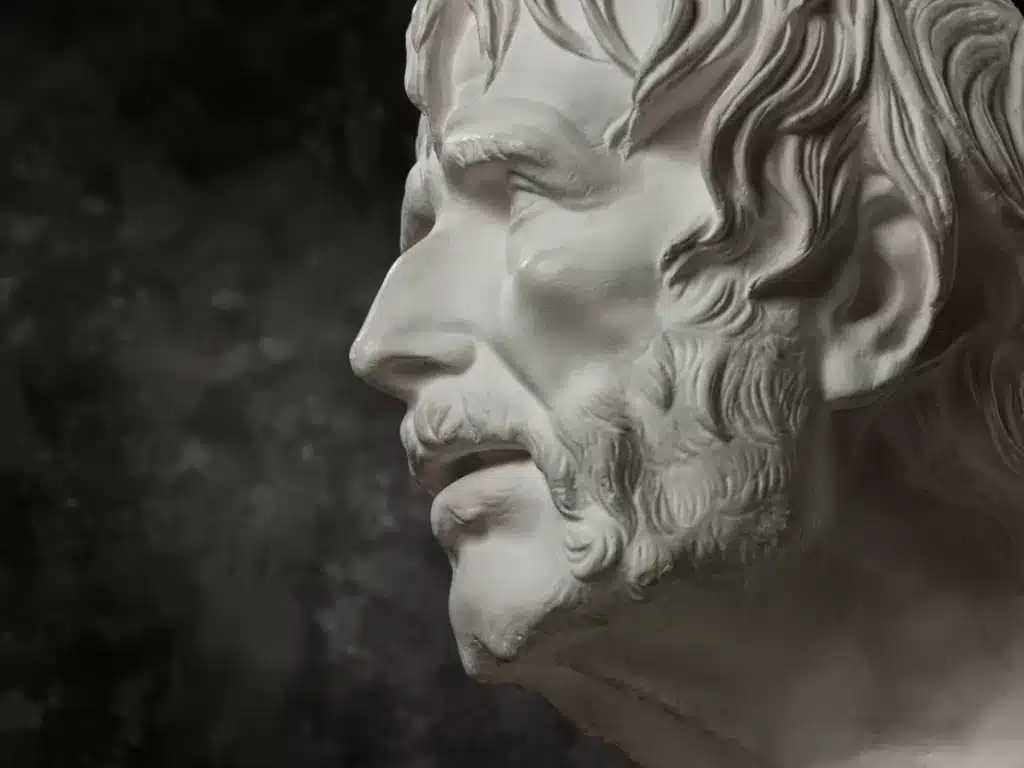
Stoic Quotes on Love & Relationships from Seneca

Nature bore us related to one another . . . She instilled in us a mutual love and made us compatible . . . Let us hold everything in common; we stem from a common source. Our fellowship is very similar to an arch of stones, which would fall apart, if they did not reciprocally support each other.

“I shall show you a love potion without a drug, without a herb; without the incantation of any sorceress: if you want to be loved, love.”

“Whoever then understands what is good, can also know how to love; but he who cannot distinguish good from bad, and things which are neither good nor bad from both, can he possess the power of loving? To love, then, is only in the power of the wise.”

Stoic Quotes on Life: The Best Stoicism Sayings & Phrases

Stoicism is all about finding inner peace and happiness in life, no matter what life throws our way. It’s about focusing on what we can control, like our thoughts and actions, and not getting too caught up in external circumstances that are out of our control.

The best Stoic quotes on life encourage us to live virtuously, find contentment in the present moment and enjoy life’s simple pleasures. It’s a great way to cultivate inner strength and resilience, and find happiness in the midst of life’s challenges.

Stoic Quotes on Life from Marcus Aurelius

“The essence of life is not in the length of days, but in the use we make of them.”

“The best way to avenge yourself on life is to be content with what you have.”

“Life is like a military campaign, you must be ready to face difficulties and sufferings, to fall and to rise.”

“The universe is change; life is understanding the mathematics of change.”

“The happiness of your life depends upon the quality of your thoughts.”

“The life of the dead is placed in the memory of the living.”

“Life is neither good or evil, but only a place for good and evil.”

“Waste no more time arguing about what a good man should be. Be one.”

“Life is not what we have, but what we do with what we have.”

Stoic Quotes on Life from Epictetus

“The key to a happy life is not to have what you want, but to want what you have.”

“We have two lives, and the second begins when we realize we only have one.”

“Life is like a play: it’s not the length, but the excellence of the acting that matters.”

“The greatest obstacle to living is expectancy, which hangs upon tomorrow and loses today.”

“If you want to improve, reject plausible reasoning, learn from your mistakes, and never be satisfied.”

Stoic Quotes on Life from Seneca

“Life is long if you know how to use it.”

“Life is not just a matter of luck, but of choice.”

“Life is a play that does not allow testing. So, sing, cry, dance, laugh and live intensely, before the curtain closes and the piece ends with no applause.”

“Life is short, but it is wide.”

“Life is not a journey to be rushed, but a journey to be savored.”

“Life is a gift, not a burden.”

“Life is a game, and it’s not about winning or losing, but about playing it well.”

“Life is not about waiting for the storm to pass, but about learning to dance in the rain.”

“Life is not a problem to be solved, but a mystery to be lived.”

Stoicism for Children: How to Teach Kids to be Stoic

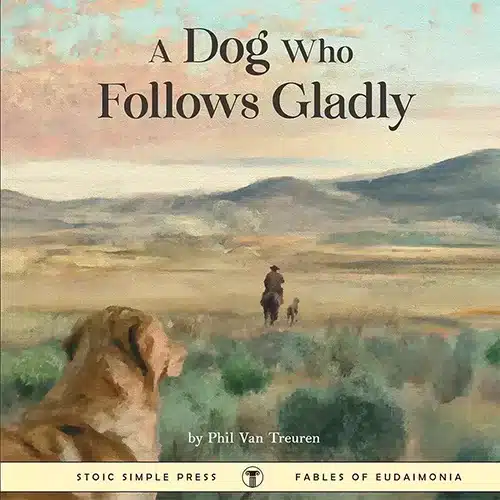
Looking for some great children’s books about Stoicism? Check out our Free Stoic Stories and our book series, The Fables of Eudaimonia.

By Phil Van Treuren

Our daughter Stella turned 5 today. When her mom asked her what she wants to be when she grows up, she said “kind.”

That makes me very happy.

Stella doesn’t realize it, but her answer is one that ancient Stoic philosophers like Epictetus would have approved of.

Epictetus taught that the way to find real happiness is by only wanting stuff that’s completely in our control.

An illustration from the Stoicism children’s book A Dog Who Follows Gladly

Being an astronaut or a firefighter or a veterinarian? That’s not totally up to us, because circumstances 𝘰𝘶𝘵 of our control could prevent it, no matter how hard we try.

But being kind? Now that’s something that we always have complete control of, regardless of what circumstances we find ourselves in.

“Choosing How Things Make Us Feel” from The Stoic Fable Book for Kids

I’ve written before about how Stoicism seems to come naturally to some people. But many of the folks who we think of as “natural born Stoics” are older adults, and their Stoic attitudes are the result of a lifetime of experience.

Children aren’t very good at controlling their emotions or analyzing their initial reactions, but there are some types of Stoic thinking that come naturally to kids.

Staying focused on what’s happening in the moment — and not dwelling on the past or worrying about the future — can be tough for adults. But for children, that kind of mindset is often second nature.

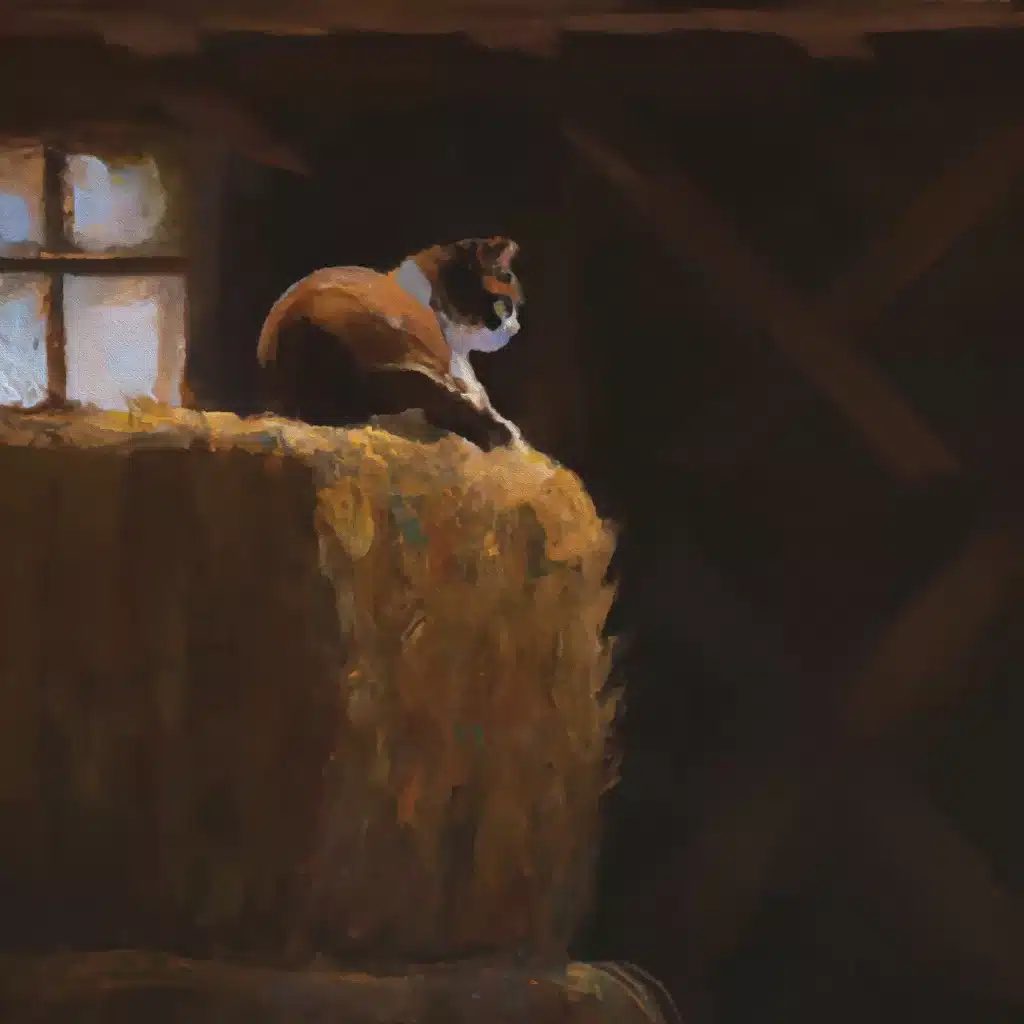
There are some great Stoicism children’s books out there (including my Stoic fable The Stock Horse and the Stable Cat) that you could read and discuss with your kids, of course. But something a bit less direct is often more effective.

The best way to teach kids about Stoicism isn’t by sitting them down and giving them a philosophy lesson. Instead, watch for stuff they do and say that reflects a Stoic mindset, and make a point of telling them that you admire them for it.

After all, it doesn’t really matter if our kids end up knowing the history of ancient philosophy or the names of the great Stoic thinkers. The important thing is that they learn to think Stoically and have a happier, fuller life because of it.

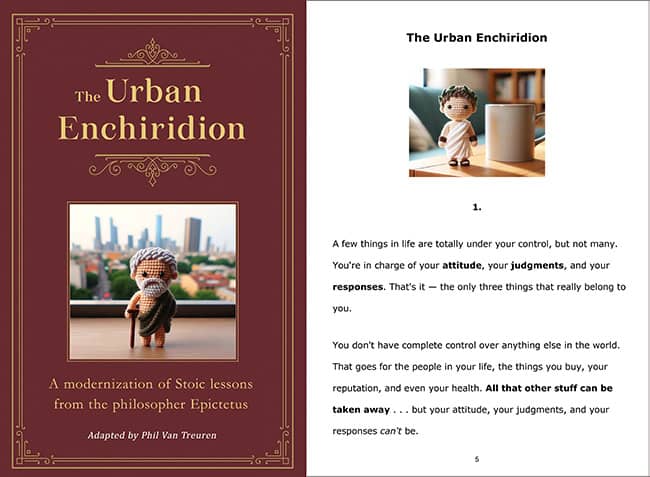
The Urban Enchiridion: a Stoicism Book for Beginners


Nearly two thousand years ago, a former slave named Epictetus opened a school in Greece . . . and became the most famous Stoic philosophy teacher in the world. The Urban Enchiridion updates his simple, life-changing lessons with modern expressions and images, envisioning how Epictetus would have talked about Stoicism if he had lived in our contemporary times.


Recent Reviews of The Urban Enchiridion

Great summary of potent philosophy in easy-to-read today’s terms

“A great distillation of Stoicism — a fine philosophy to live by — written in a simple, understandable way for today’s times. Very actionable advice that seems simple but is packed with complexity as well. You can find something to work on with any and every read. Worthwhile to keep on hand as a reference for honing in on inspiration for the challenges of the day.”


What is The Enchiridion?

Okay, we should get this part out of the way first: the word is pronounced “EN-KA-RID-EE-UN.” (Don’t worry, I didn’t know how to pronounce it when I first saw it, either.)

A couple thousand years ago in Greece, there was a school of Stoic philosophy run by a guy named Epictetus (pronounced “Epic-Teetus”). He was a former slave who had one hell of a tough life, but after being freed he became the most famous Stoicism teacher in the world.

Lots of important Roman families sent their sons to learn about Stoicism from Epictetus at his school. (It was sort of like how rich people today sign their kids up for boarding schools that will look good on their resumes.) People came from all over the place to listen to his lectures — even Hadrian, who was Emperor of Rome, made a trip to attend a few classes.

Epictetus never wrote any stuff down himself that we know of. But one of his students, Arrian, took some really detailed notes of what Epictetus said in class, and published them later. He called a part of those notes The Enchiridion, which basically means “handbook.”

The Best Stoicism Book for Beginners


This collection of teachings from Epictetus has been translated into dozens of languages, and it’s one of the most important ancient books we have about Stoicism. A lot of people who read it are seriously amazed at how simple, powerful and life-changing the lessons in The Enchiridion are, and I think it’s the best book for beginners to learn about Stoic philosophy.

A scene from Nicopolis, Greece, where Epictetus started his school.

But here’s the problem: the translations aren’t read as much as they could be . . . because for the average person, they’re kind of boring.

You’ll notice, though, that I never said Epictetus or his lessons are boring. In fact, I think Epictetus was stimulating, clever, and sometimes laugh-out-loud funny. He even comes across as a bit of a smartass on some pages (it was probably quite an experience to sit in one of his classes).

Roman Emperor Marcus Aurelius learned from his own personal copy of The Enchiridion.

It’s the available translations of his lessons that are sometimes boring, because most of them just regurgitate the same archaic speaking style and imagery that people used two thousand years ago.

Some people might like reading translations that use old-fashioned, antiquated language, and that’s fine. But those shouldn’t be the only kind of translations available to people who want to know what Epictetus taught.

Anyway, that was the thinking behind this project. While I adapted The Enchiridion, I tried to imagine the words Epictetus might use if he’d been born in our time, and lived in the same environment that we do.

An illustration of Epictetus from an Enchiridion translation printed in 1715.

Our world might be very different than it was two thousand years ago, but people are still basically the same. My hope is that The Urban Enchiridion helps a few more of us discover just how simple it is to change our lives for the better with Stoic thinking.

Phil Van Treuren

Natural Born Stoics: Why Some People Have Built-In Stoicism

You’ve probably met a few yourself: those rare and remarkable people who seem to be born with ingrained Stoicism. Here’s why Natural Born Stoics are so common throughout history . . . and why they don’t need any help finding a philosophy of life.

by Phil Van Treuren

“They develop an ability to avoid needless anxiety, to enjoy the world around them, and to remain optimistic in the face of setbacks.”

William B. Irvine on Natural Born Stoics

When I was a twenty-something, I asked my grandfather if he’d been scared while going through months of radiation treatment for prostate cancer.

“No,” he said matter-of-factly. “There was nothing I could do about it, so worrying wouldn’t have made any difference.”

I doubt that my grandfather — who is now cancer-free and living independently in his 90s — has studied the works of many ancient Stoic philosophers. But he probably wouldn’t gain much from it, anyway.

The author with his grandfather in 1979

At the time I asked about his cancer treatment, my grandfather’s answer was something I couldn’t even comprehend. I never considered that people could simply choose to not worry about stuff that was out of their control.

Today — after reading my weight in books on Stoic philosophy, both ancient and modern — I realize that my grandfather had already given me a lifelong example of the right way to practice Stoicism before I even knew what the word meant.

You might have a Natural Born Stoic like my grandfather in your own life (there are plenty of them out there, after all). Stoicism is second-nature to these fortunate folks . . . but most of them probably don’t know (or care) what Stoic philosophy is.

Three Reasons Why Some People Have Built-In Stoicism

It’s not impossible to simply be a born Stoic, but what seems to be spontaneous Stoicism is often the result of both nature and nurture. Even those of us who strive to think Stoically might have to overcome natural roadblocks like anxiety and depression, which make it very difficult to simply “choose” to not worry.

Here are three reasons why “congenital Stoics” exist among us, and how you can use their example to become more naturally Stoic yourself.

#1: Stoic Thinking is Just Basic Human Nature

Stoicism wasn’t “created” by philosophers, it was identified by them. Think of ancient Stoics as scientists or psychologists, who studied basic human nature and classified the kind of thinking that lets us be happier and more resilient.

Stoicism is just a “catalogue” of the most effective ways to think — so it makes sense that plenty of people naturally discover these methods on their own. Even if we lost every word that was ever written about Stoicism, the concepts would be re-discovered by human beings again and again.

Some people are born with natural athletic ability, but most us have to train and practice to become athletic. The same goes for logical thinking: a few have it innately, while others need tools like Stoicism to learn it.

#2: Stoicism is Nurtured by Experience & Enduring Challenges

Most naturally Stoic people have one thing in common: plenty of life experiences to look back on and learn from.

Not many toddlers are Stoic, because they haven’t been around long enough to learn what kind of mindset makes life easier. As you’d expect, Stoic thinking is much easier to find in older people who’ve successfully navigated their share of challenges.

But it’s not just living a long life full of challenges that leads to a Stoic mentality. Many people who’ve had difficult lives end up bitter, blame the world, and choose to identify as victims.

The gift of “ingrained Stoicism” comes to those who’ve learned to remain grateful in spite of hardship, look for opportunity in every setback, and accept that some things are out of their control.

#3: A Stoic Mindset Can Come From “Learning by Example”

Some people were lucky enough to have an influential mentor in their early lives who showed them how to embody Stoicism. Like many things learned through example, the real benefit we get from Stoic parents or grandparents might not come until much later in our lives — perhaps even after they’ve already left us.

When life’s inevitable hardships knock at our door, we can be bolstered by recalling the Stoic way in which our mentors faced the same challenges.

Whether they realized it or not, the actions of those who loved us in our youth are more valuable than the written words of any ancient philosopher.

A note from the author:

This article was inspired by the writing of William B. Irvine, and I first read about the concept of “congenital Stoics” in his book A Guide to the Good Life. I hope you’ll add Professor Irvine’s great books on Stoicism to your reading list.

Plato’s Academy Centre Interview with Phil Van Treuren

Plato’s Academy Centre posted a great interview today with Phil Van Treuren, the author of The Stock Horse and the Stable Cat (a Stoicism fable published by Stoic Simple Press in December, 2022). We hope you’ll take a moment to go check it out!

Plato’s Academy Centre is an organization dedicated to promoting philosophy as a way of life. Their goal is to raise funds to open an international conference venue at the historic location of Plato’s school of philosophy in Athens, Greece.

Three Ways to Find Purpose: What’s the Meaning of Your Life?

If you’re asking the world to show you the meaning of life, then you’ve got it backwards. The world is asking you that question . . . and there are only three places to find the right answer.

by Phil Van Treuren

“It doesn’t really matter what we expect from life, but rather what life expects from us.”

Viktor Frankl

“What is the meaning of life?”

There are few questions that are more human . . . and few that are more arrogant to ask. It’s a bit like going to a job interview and demanding to know what they can do for you, rather than showcasing why you’re perfect for the position.

The world is asking the questions, and the world doesn’t really care what you expect from it. But here’s the good news for Stoics: real meaning doesn’t come from what the world gives you, but how you respond to it.

3 Paths to Purpose: Creating, Caring & Conquering

“Life ultimately means taking responsibility to find the right answer to its problems and to fulfill the tasks which it constantly sets for each individual.”

Viktor Frankl

Focusing on what you “deserve” from the world won’t help you discover purpose (and will end in disappointment, anyway). Instead, Stoicism teaches to stop asking questions and look to the tasks that life is putting in front of you.

It’s in dealing with life’s requirements — yes, even the most painful ones — that you’ll find the best reasons for existing.

There are three ways to do that: by CREATING stuff out of materials that the world gives you; by CARING for people who the world puts in your life; and by CONQUERING unavoidable suffering that the world puts you through.

#1: Creating Stuff

“What man actually needs is not a tensionless state but rather the striving and struggling for a worthwhile goal, a freely chosen task.”

Viktor Frankl

We can’t choose what the world gives us to work with, but we can choose how we use, shape, organize and build with it.

You don’t have to be the best at something to find purpose and joy in it. Our ancient ancestors found just as much fulfillment in creating stuff with rocks as Leonardo da Vinci got from painting the Mona Lisa.

Finding meaning in life through work, art, writing, bettering ourselves, hobbies and even menial tasks are all forms of “creating.” Any challenge that involves using your surroundings, making new things or improving something is an opportunity to find purpose — regardless of whether it’s glamorous or not.

#2: Caring for Others

“The more one forgets himself—by giving himself to a cause to serve or another person to love—the more human he is and the more he actualizes himself.”

Viktor Frankl

This source of meaning is the simplest to understand, because it’s so deeply ingrained in the experience of being human. Every person has the opportunity to find purpose in life by caring for others; whether as a friend, a teacher, a parent, a leader, or even as an anonymous supporter.

The joy of caring for others isn’t just limited to direct relationships with people. This kind of meaning can also be realized by involving yourself in causes and charities, helping groups and organizations, and living your life in a way that will help others when you’re gone.

#3: Conquering Unavoidable Suffering

“We may also find meaning in life even when confronted with a hopeless situation, when facing a fate that cannot be changed.”

Viktor Frankl

The important part first: Stoicism does not teach that suffering is necessary to find meaning in life. If you can avoid suffering, then you absolutely should.

But if our suffering is truly unavoidable, then it’s possible to find significant meaning in how we face the pain, or how we “conquer” it. When the world drops a difficult challenge on us, we can make it our mission to distinguish ourselves by bravely facing it.

Keep in mind that conquering unavoidable suffering doesn’t necessarily mean we make pain go away. We can “conquer” suffering, disability and even death by how we choose to deal with them.

Unavoidable suffering — whether from illness, accidents, old age or loss — visits all of us, eventually. When it does, it’s possible to find purpose by accepting that it’s our own, unique task to face the suffering. We can both define ourselves and provide an example to others by how we bear it.

A note from the author:

This article was inspired by the writing of Viktor Frankl, an Austrian neurologist, psychiatrist and Stoic philosopher. If you’d like to learn more about his work, please check out his book “Man’s Search for Meaning,” which chronicles his experiences as a prisoner in Nazi concentration camps during World War II.

The Dangers of Nostalgia: Why It’s Unhealthy to Dwell on Happy Memories

by Phil Van Treuren

“True happiness is to enjoy the present . . . not to amuse ourselves with either hopes or fears but to rest satisfied with what we have, which is sufficient, for he that is so wants nothing.” — Seneca

Can nostalgia be unhealthy? If you dwell too much on happy memories, yes.

The important part first: happy memories are good things to have. But dwelling on them too much — and falling victim to sentimental longing — can make us blind to the good stuff in our present.

People who are into Stoicism know how important it is to focus on the present and not think too much about the past. But what if I told you that this rule applies to memories of good experiences as well as bad ones?

It’s fine to let yourself smile at a happy thought of the past occasionally, but every Stoic should beware of nostalgia. It can quickly turn into sentimental longing, which feeds stuff like depression, self-pity and ungratefulness.

Nostalgia is a bit like alcohol — a drink or two is fine, but once you start it’s easy to overindulge. What’s pleasant in small amounts can quickly lead to suffering.

The “tipping point” for nostalgia comes when you start comparing your happiest memories to what you’re experiencing in the present. If you’re indulging in nostalgia, be careful not to fall into the trap of thinking today must be bad, because yesterday was better.”

We’re especially vulnerable to the dangers of nostalgia when we’re already feeling lonely or depressed about something. If you’ve recently gone through a breakup or divorce, for example, sentimental longing can lead to a spiral of unhealthy thinking.

There are times when lingering over the old photos, listening to the nostalgic music, and losing yourself in the happy memories can be bad for you.

Dwelling on bad experiences is unhealthy . . . and dwelling on good experiences can be, too.

Don’t be sad that a good experience is over. Instead, be grateful that it happened . . . and then choose to go and have more good experiences. There are people and opportunities in your present that deserve your attention.

Better to think of the past very little, and focus instead on today. Be thankful for what you have now, and don’t compare it to anything else.

Stoicism: the Perfect Philosophy for an Age of Artificial Intelligence?


Humanity is on the edge of an unprecedented transformation, and few of us are prepared for how quickly artificial intelligence will change our lives. Here’s how Stoic thinking can help us embrace the coming revolution and thrive in a vastly different world.

by Phil Van Treuren, 6-1-2022

“Everything you see will soon alter and cease to exist. Think of how many changes you’ve already seen; the world is nothing but change.”

Marcus Aurelius


The world isn’t ready for what’s coming . . . but it will come nonetheless.

That could be said about countless transitions in human history, but breakthroughs in artificial intelligence will soon usher in the most exciting and opportunity-rich era that humanity has ever seen.

The rewards will be available to everyone, but they’ll only be reaped by those of us who can embrace inevitable change and accept things that are outside of our control.

Sadly, for a big percentage of the population — those who refuse to adapt, learn new things or reinvent themselves — the next few years might be aggravating, confusing and even frightening.

That will be their choice to make. But rather than mocking or ostracizing them, true Stoics will offer understanding and guidance. Don’t forget how rewarding it can be, mentally and physically, to do things “the old fashioned way.”

How AI Will Transform the World with Unprecedented Scope & Speed


Most of the world hasn’t noticed the mind-blowing advances made in the field of artificial intelligence over the last year. Some attention has been given to generative AI like DALL·E and ChatGPT, but media has largely focused on outrage from artists and writers who’ve been blindsided by the technology.

Generative AI creates new content — like images, artwork, articles and stories — modeled on human-created examples. By training itself with existing content amassed in giant databases, the AI learns to create new content in similar styles.

Generative AI observes content, gets a feel for unique styles, and then produces its own stuff based on what it learned. Human artists and writers do the same thing when they learn their craft . . . they just do it much, much more slowly.

” . . . accommodate and adapt. The mind adapts and converts to its own purposes the obstacle to our acting. The impediment to action advances action. What stands in the way becomes the way.”

Marcus Aurelius


Generative AI is amazing enough by itself (and will rapidly get better as it learns to create content that surpasses anything from humans). But it’s only a whisper of the shock wave that’s coming.

AI’s ability to analyze massive amounts of data and improve existing systems will soon be applied to more fields than you might imagine. Medicine, law, economics, biotechnology, energy, food production, logistics, entertainment, manufacturing . . . these are just a few arenas where you’ll see artificial intelligence start to be applied in the next few years.

In fact, it already is being applied and prepped for launch. Much like generative AI suddenly emerged this year, the advances in other fields will seem, for most people, to come out of nowhere.

Humanity’s Looming Identity Crisis


The AI revolution will be great for humanity, allowing us to be healthier, happier and more fulfilled than ever before. But initially, as people realize that AI will make their professions obsolete and their talents unremarkable, we’re in for a rough adjustment period.

First will fall the artists and writers, like me. In the very near future, AI will be able to create an article like the one I’m writing now . . . but it will write it much faster, and much better.

Soon after that, other professionals who thought their jobs could never be replaced by AI will start getting nervous.

“Everything’s destiny is to change, to be transformed, to perish. So that new things can be born”

Marcus Aurelius


Attorneys will watch AI do a better job at studying ordinances and presenting legal arguments. Doctors will watch AI do a better job at analyzing patient health and prescribing preventative treatments. Staffers will watch AI do a better job at answering phones and responding to emails.

AI will develop more effective medicines, discover cures for diseases, create stronger construction materials, and invent new machines that make living and learning easier for all of us.

The rise of artificial intelligence is not going to mean Armageddon for humanity, and it won’t condemn anyone to poverty unless they choose to be. But people who define themselves by their careers (yes, even you) may find the next few years to be nerve-wracking.

That’s why now is the perfect time to learn that our happiness isn’t controlled by external stuff like jobs and technology . . . and that we can always find joy in our talents, regardless of whether we’re the best at them.

Some Tips for Using Stoicism to Cope & Thrive in a Wildly Transformed World


Although it was developed thousands of years ago, Stoicism may be the perfect philosophy for a society on the cusp of a technological revolution.

Remember: the world around us might change dramatically, but humans — and human nature — remain the same.

Accepting stuff outside of our control, choosing to be happy regardless of external circumstances, and turning obstacles into opportunities are all core tenets of Stoic thinking.

“If anyone can show me I’m looking at things from the wrong perspective, I’ll gladly change. What harms us is to persist in self-deceit and ignorance.”

Marcus Aurelius


Stoicism is a philosophy meant to be applied directly to our lives, and it was designed to be simple. Here are a few ways to apply Stoicism in the coming years that will help you thrive as the world transforms.


#1: Don’t worry about stuff you can’t change.

When the integration of AI starts to become more noticeable, a lot of people will get upset and attempt to stop it. They’ll try protesting, boycotting, and even outlawing artificial intelligence.

They’ll fail, just as the Luddites failed in their attempts to stop textile automation back in the 19th century. But some people will continue being angry about AI for the rest of their lives.

Don’t be one of those people. Technological advancement isn’t something you can change, so don’t waste time worrying or getting angry about it. Instead, accept that it’s going to happen and focus on being happy and productive in new, inevitable surroundings.

#2: Turn the obstacles into opportunities.

It might be tempting to look at artificial intelligence as an obstacle to your happiness — especially if it threatens to make your job obsolete. But don’t let that blind you to the countless opportunities AI will create for people to make a living in new, exciting ways.

Rather than bemoan AI, start learning about it, having fun with it, and finding ways to exploit it. Figure out how it can magnify your natural talents and help you create stuff that was impossible when you started your career.

It’s natural to experience some apprehension — and even a little fear — around things you aren’t familiar with. Don’t let that stop you from staying flexible, reinventing yourself, and taking advantage of new opportunities that AI will bring.

#3: Look for joy and purpose in yourself, not in externals.

No matter how much AI advances, it can’t take away your talents, passions, experiences and choices. You can still find joy in creating and nurturing things you love, regardless if machines can do the same stuff more quickly and with fewer flaws.

If your personal identity is attached to your career, start visualizing how you might find purpose while doing something different. Your worth isn’t defined by your job, and feeling happy is better than feeling important.

#4: Resolve to have fun and practice gratitude.

It’s not change that upsets us, but our judgments about change (that’s from Epictetus, by the way). Happiness really is something we choose, and AI will make lots of fun new experiences possible. You could enjoy it . . . if you let yourself.

Allow some gratitude into your thoughts, too, for being alive at such an amazing time in human history. We have the opportunity to learn more, live healthier, and experience stuff that our ancestors could never have imagined.

#5: Be patient as others find their way.

Because of how quickly AI will become integrated into our daily lives, many people will be surprised and frightened by it . . . especially the older generation. Be patient and try to help them understand new technologies, but respect anyone who chooses to continue doing things “the old fashioned way.”

Using our own minds and bodies to do things slowly, deliberately and carefully can be rewarding in many ways. Friends and loved ones who don’t want to cut corners with artificial intelligence will still have a lot to teach you about life, too.

Don’t be afraid to “disconnect” every now and then to let them remind you what it really means to be a human being.


A Note from the Author:

All of the research, writing, editing and image creation for this article was done on my cell phone, with my thumbs, in my spare time.

No one taught me how to do any of it, but I had to learn to use some technology that I wasn’t comfortable with a year ago.

It was easy . . . and it can be just as easy for you. Embrace uncomfortable change, use it to become better, and don’t let anything about the future intimidate you.


Musonius Rufus Stoicism Quotes

“In philosophy, rather than showing lots of complicated examples, seek a few clear ones.”


“Live like a doctor, and constantly treat yourself with the medicine of reason.”


“Trying to hurt every enemy you meet? This is the mark of a cold-hearted and ignorant person.”


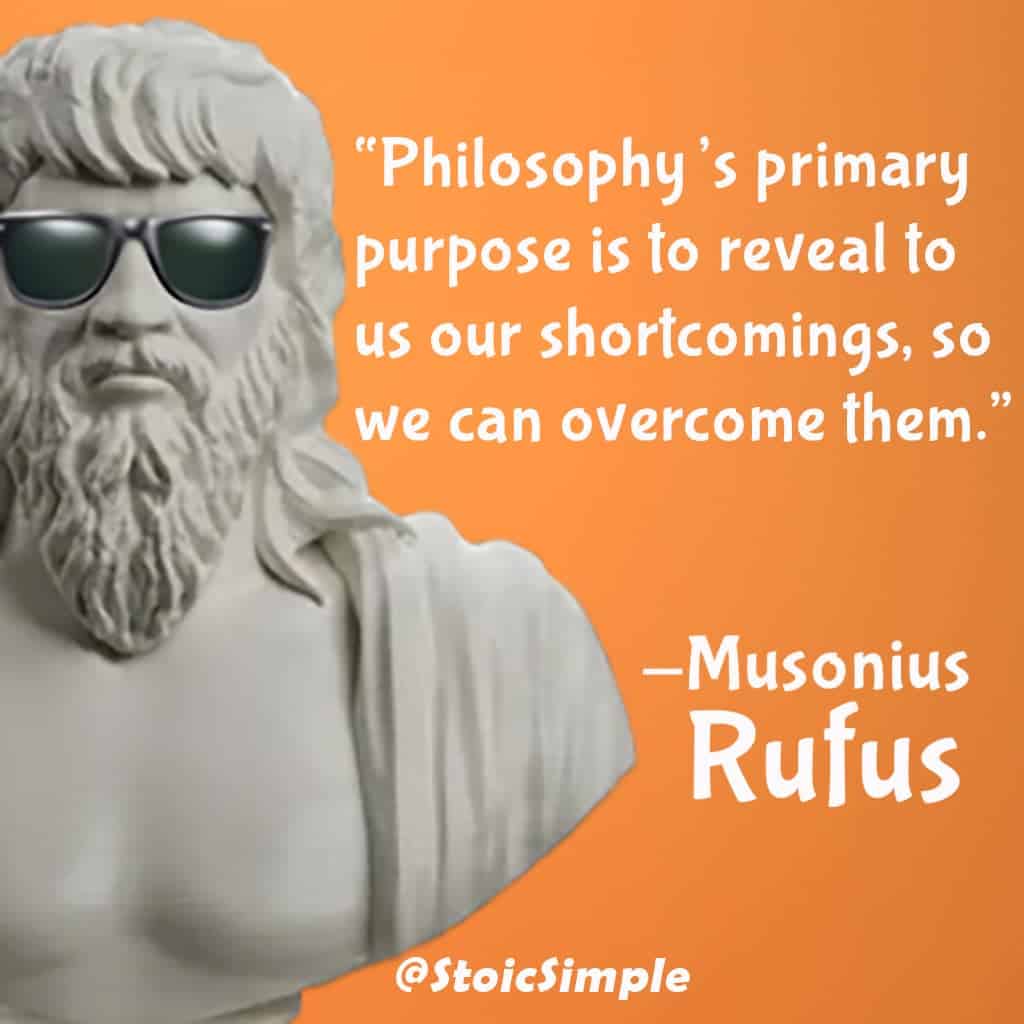
“Philosophy’s primary purpose is to reveal to us our shortcomings, so we can overcome them.”


“Let philosophy be like nutritious food or physical exercise, staying with us and always guarding our judgments.”


“Seek what is NOT simple and obvious by using the simple and obvious.”


“To forgive those who wrong us is the proof of a benevolent way of life.”


“Don’t expect to encourage good deeds in other people if they are aware of your own misdeeds.”


“Willingly accept the inevitable, and you will lead a life in harmony with the universe.”


“Just as a stone falls if you throw it up, good people will continue being good even if you try to repel them.”


“We gain every good by experiencing the toil in our lives.”


“Train yourself to strive for giving, rather than receiving.”


“The soul is trained for courage when we show patience under hardships.”


“Don’t just say that some things should not be feared, but actually show courage in the face of them.”


“It’s better to actually be self-controlled than to tell others how they ought to live their lives.”


“Every child should be trained to not be disheartened in the face of misfortune, and to endure hardships.”


“To relax your mind . . . is to lose it.”


“Reflect on how many things have happened that you didn’t want, and yet they turned out for the best.”


“Have a firm conviction that hardships, and even death, are not evils.”


“Most people who criticize tyrants have the same inclinations, they just lack the chance to act on them.”


“You’ll earn the respect of all men if you begin by earning the respect of yourself.”


“It’s not possible to live well today . . . unless you treat it as your last day.”


About Gaius Musonius Rufus

Gaius Musonius Rufus was a Roman philosopher and teacher who lived during the first century AD. He is considered one of the most important Stoic philosophers of his time, and his teachings had a profound impact on Roman society.

Born in Volsinii, Italy, Rufus came from a wealthy and influential family. He studied philosophy under various teachers, and eventually himself became a teacher of the famous Stoic philosopher Epictetus. In AD 60, he was exiled to Gyaros, an island off the coast of Greece, for his teachings.

Despite his exile, Rufus continued to teach and write about Stoicism. He believed in living a simple, virtuous life, and his teachings focused on the importance of self-control, virtue, and wisdom. He also believed in the equality of all people, regardless of their social status or gender.

Rufus was also a strong advocate for women’s education and rights. He believed that women should be educated and allowed to participate in public life, and he taught both male and female students.

During his time in Gyaros, Rufus wrote several influential works, including “On the Good Man,” “On the Cynic,” and “On the Stoic Life.” These works were widely read and had a significant impact on Roman society.

After his exile, Rufus returned to Rome and continued to teach and write. He was eventually arrested and sentenced to death by the Roman authorities, but he was later pardoned and released. He continued to teach until his death in AD 101.

Rufus’s teachings continue to be studied and admired by philosophers and scholars today. His emphasis on virtue and self-control remains relevant and inspiring, and his advocacy for women’s rights was truly ahead of his time. His life and teachings continue to inspire and influence people around the world.

Exit mobile version